Showing posts with label Star Adventurer. Show all posts

Friday, April 5, 2019

Putting the Skywatcher Star Adventurer through the paces

Tested the EF 400/5.6 and the Sigma Art 135/1.8 on the Adventurer during one clear sky night this week. With some prolonged Polaris alignment I managed to make some shots with the 400mm until the camera ran out of juice unfortunately after about only 10 shots without me noticing.

After swapping to a fresh battery I also tested using the 135mm.

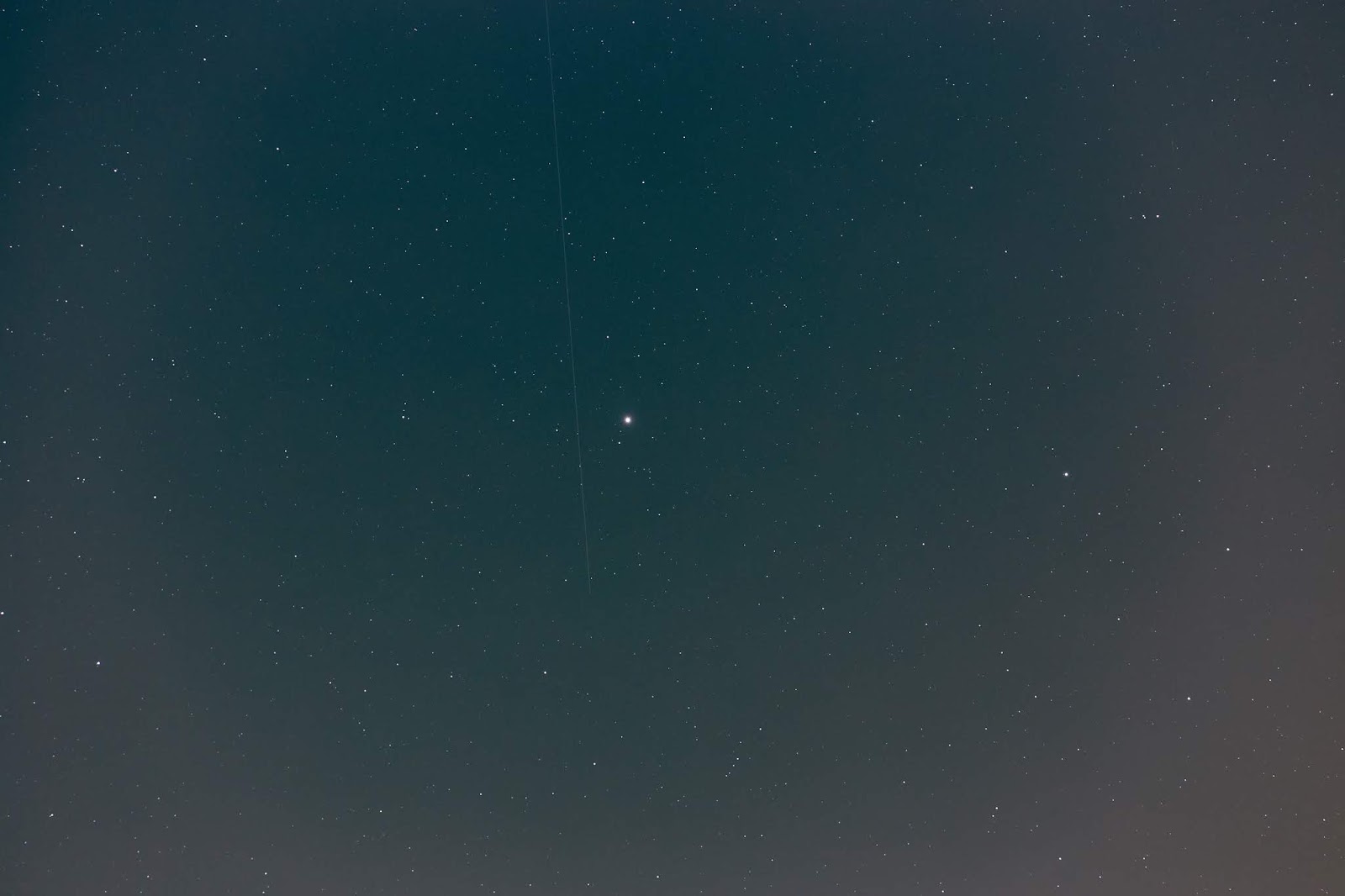
The target was Arcturus,  the brightest star in the constellation of Boötes, the fourth-brightest in the night sky, and the brightest in the northern celestial hemisphere. Arcturus is part of the Spring Triangle asterism together with Spica and Denebola.

With short exposure ie less than 10secs you can get away with a more or less Polar alignment which is what I've been doing thus far. With proper alignment even the 400 managed to get to 45 secs. The 135 managed to take it all the way to 83 seconds.


EF 400/5.6 shots above, max exposure reached this time was 45secs (above shot was 30secs and 45secs). 


Art 135/1.8 max exposure achieved was  83 secs (shots above vary from 30 secs to 83 secs).


Arcturus, is associated with the arrival of spring , and in the southern hemisphere heralds the start of autumn, here a stack of 135mm shots only lights, cropped.


Since the objective of the Star Adventurer was only to make longer exposures of the Milkyway and possibly also of the M42 Orion Nebula, I think the Adventurer has now proven more than fulfilled the tasks it's supposed to be doing.

Incidentally now that I have gained better experience with Polar alignment, there's less reason to leave the Adventurer at home and limit my exposure time. More tracked shots of clear sky undoubtedly. Here's to more clear skies!

Friday, March 1, 2019

Imaging at Vaulen Beach

Vaulen Beach is located only a stone's throw away down the hill from the house. Popular with residents in the area during the warmer months, in winter only dogwalkers come aroudn to walk their charge during the day.

It has perfect view East and NorthEast however with the amount of light pollution from nearby houses and streetlights the location is not on the top spot of most nightstalkers. I have attempted shooting here a few times but always get frustrated with the excessive lights. Also being popular with dogs and their walkers during the day, walking around at night around here carry certain risks. I brought back dog poo into the garage on one occasion courtesy of the front tire of the car.

Looking Northeast.


Star Adventurer pointed East.

Radio tower across the fjord.


Orion in March

After almost a week of cloudy and/or foggy sky the stars revealed themselves when both elements took flight finally. Though they are not completely gone it was clear enough for some night time imaging.


The night sky full of stars 28th Feb/01st Mar 2019

Star Adventurer for trail-less longer exposures.


The constellation Auriga with it's brightest star Capella almost directly overhead 01st Mar 2019.


While some friends were chasing KP3-4 aurora in the moisture laden lower elevation sky, I decided to give the stars a shot or two. The temperatures wasn't extreme but the grip of winter has completely been let go so it was cold around midnight, colder still when wind blew.


I attempted another session at Vaulen with the intention of getting away from light pollution, however being located right smack in the city this proved rather futile. Light pollution is everywhere and it seems you can't escape it no matter where you are in the city.


Tuesday, February 12, 2019

Chasing Comet Iwamoto

Trying my luck at Comet Iwamoto tonight ... supposedly magnitude 7 between 10-13th of February with it's trajectory crossing the Leo constellation. I caught Comet Wirtanen earlier in the year without tracking, so this time I'm trying to capture Iwamoto with tracking ...  hopefully it's in the frame somewhere. I'm using the Sigma Art 135/1.8 on Canon 6D mounted on the Star Adventurer.

Since clear sky is hard to come by on the West Coast, I'm onto the chase ... fingers crossed I got it!

Rapidly moving to the northwest, Comet Iwamoto zips from Virgo to western Leo in the coming week. The open circles mark the comet's position for 0h UT (7 p.m. on the previous date EST) daily; the crosses mark its location at 12h UT (7 a.m. Eastern). Stars are shown to magnitude 7. From https://www.skyandtelescope.com/observing/comet-iwamoto-ascends-and-brightens/


An attempt without tracking Sony A7S+Samyang AF85/1.4 @f/2.8. So this is basically done with continuous single shots at 1secs exposure to minimize trailing, and then stacked using Sequator.

Another attempt without tracking Sony A7S+Samyang AF85/1.4 @f/2.8


Tracked shots, 95 shots on Star Adenturer 30secs exposure each @ f/2.8, Iso 400 at every 35secs interval, and then stacked on Sequator. We can see that that the Comet Iwamoto moves really fast!


With the current winter weather there are very limited options for travelling to an LP free location, perhaps later in the fall there would be more opportunities to assess the stupendousness of Star Adventurer tracked shooting of the night sky. But then again there is always Tenerife, La Palma ... however dragging gear across international airports becomes a big drag, literally.

Saturday, February 2, 2019

A patch of clear winter sky amidst light pollution

Winter typically holds very nice conditions for night sky imaging. Cold dry moisture free air affords quite amazing viewing as well as being superb for star photography. Bundled up adequately against the wind and cold the quiet late night can be invigorating. The only item that would make it  perfect would be the ability to switch the light pollution off. We are in the city afterall.

Canon 6D+EF50/1.2 @f/2.0+15secs+Iso400, Star Adventurer, stacked in Startrail

Canon 6D+EF50/1.2 @f/2.0+15secs+Iso400, Star Adventurer, stacked in Startrail

Sony A7S+Samyang 85/1.4@f/2.0+15secs+Iso500, Star Adventurer, stacked in Startrail

Sony A7S+FD35/2.0, single shot

Sony A7S+FD35/2.0, single shot

Sony A7S+Sigma 135/1.8 @f/2.0,1 secs, Iso 100, single shot

Sony A7S+Sigma 135/1.8 @f/2.0, 1 sec, Iso 100, single shot


And of course after many sessions of night sky imaging in the cold, the best stories has always been about the biggest one that got away. While fiddling with the settings on the camera a fireball whizzed by right above the city just to the side of me ... obviously not recorded on the camera. Another one of those Big Misses, if only ...

Monday, January 28, 2019

Orion, single shot and stacked shot

Stacking fully aligned star shots is made possible with Star Adventurer. The unit with a camera sitting on top of it  follows the earth's rotation around the polar axis thus should eliminate the issue of star trails especially for long exposures. Multiple single shots exposure are taken over a certain time window, then these shots are stacked with a chosen stacking software. The reference standard software for stacking has always been the Deep Sky Stacker. DSS is available for free from the web. It has all the buttons you need for a successful stacking operation.

Since swapping laptop this year I'm no longer able to use some of my favorite softwares among them DSS and Photoshop. So now for a quick and dirty stacking I use Sequator which was recently made available by it's developer also free of charge. It is so much easier to use however with much less options for tweaking the stacking process.

One single shot at 15secs tracked.

A stacked of 12 tracked shots at 15sec each.

The view beneath that of Orion (stitched), light pollution is the bigger issue with astrophotography.

Milkyway from Sulaskard 2017 f/1.2 @ f/2.8 on Sony A7S, single shot tracked, minimum light pollution.


The main isssues with trying to image the night sky falls into two main categories. Those within a photographer's control: 
1) Aperture - wider aperture lets in more light, thus shorter exposure time, less noise, less trailing
2) Sensor size - larger sensor, less noise.
3) Earth's rotation - compensated for by star a tracking device, longer exposure, less need for widest aperture

And the issues outside of a photographer's control :
1) Weather - not much one can do other than more to Tenerife and pray for clear sky
2) Light pollution - seek dark sky (within our control to a certain measure)

A star tracker could possibly solve item 1 and 2 in one swipe, with the tracker you can probably get away with a crop camera, an f/4.5 lens and stacking combination. However the same combination with a fullframe camera and an f/1.2 lens would take your image that much further than a crop sensor  can.

It took me many years to progress from shooting stars and Milkyway with a crop sensor and f/4.5 lenses purely on a account of cost, and partly commitment. Then I saw a lot more of the sky when I moved to fullframe and f/1.2 (big glass) lenses. Then I bought the Skywatcher Star Adventurer, it took me about  a year before I actually dragged it out for a session with the Milkyway.

As for my night sky imaging, I can say that I'm working hard on the motivation and commitment on my part. Along the journey I've also picked up a couple of f/1.4 lenses as well as tripods.

The best I could do with a tripod, crop sensor Canon 40D and f/4.5 lens ... trying to capture fireflies and the stars at Sg Kadulit, Kuala Suai, near Miri, Sarawak. This was several years before Sony A7S!

An attempt at Milkyway (Sep 2011) with Canon 40D+Tokina 16-35/2.8: Iso1000, 30secs,f/2.8. I was shooting Jpeg, WB 5000.

Friday, January 18, 2019

Clear Night, Star Adventurer

It was a clear winter's night when I woke up to checkout the stars around midnight. The moon hovering above the magnificent Orion, I already spotted the conjunction earlier in the evening. I decided to photograph them and put out the Star Adventurer. Many an attempt previously has ben thwarted by either clouds, strong winds, cold or just pure laziness. And it's only minus 1 deg C last night.

A Star Adventurer (left) I appropriated from the manufacturer's website.

A tracked shot at 20sec, f/5.6, Iso 100. Typically even at 8secs a 35mm would produce visable trails.

Untracked shot at 0.5secs.

A stacked of 10 shots of 0,5sec exposure each.

I was able to shoot at this exposure combination 20secs, Iso 100 with the 35mm @5,6 and  85mm @2,8 from the trackers aligned to the north star without any noticeable start trail. It would be interesting to push the exposure further to 30secs, 45secs or even 60secs ... however for that we'd have to find a light pollution free zone to avoid excessive city lights.

A tracked shot of Orion (no trail) and clouds (trailing)  this time at 30secs.

A tracked shot this time at 30secs.
A stacked of 12 shots at 20secs per shot. 20secs exposure without a tracker will produced star trailing dt earth's rotation. Longer exposures at lower iso are now possible with a star tracker.