Showing posts with label Orion. Show all posts

Saturday, January 28, 2023

Orion Nebula Quick Attempt


Panasonic Lumix S5 + Askar 200/4 LP Filter


Panasonic Lumix S5 + Askar 200/4 LP Filter


Reference shot from Ben Barakat.


An attempt made during one of those clear winter night, actually this morning. Looks like another failed attempt since the loop's pattern looks a bit dodgy, resembling some artifact created from internal reflection or something. Shot is made over Sola Airport (not exactly light pollution free). This a stack of 13 single shots of 1 sec exposure untracked. The street lamp in the driveway is on the left. I'm thinking that is the source..

Will try again as opportunities present themselves aka clear nights. Maybe even drive out to a darker location.


Sunday, November 14, 2021

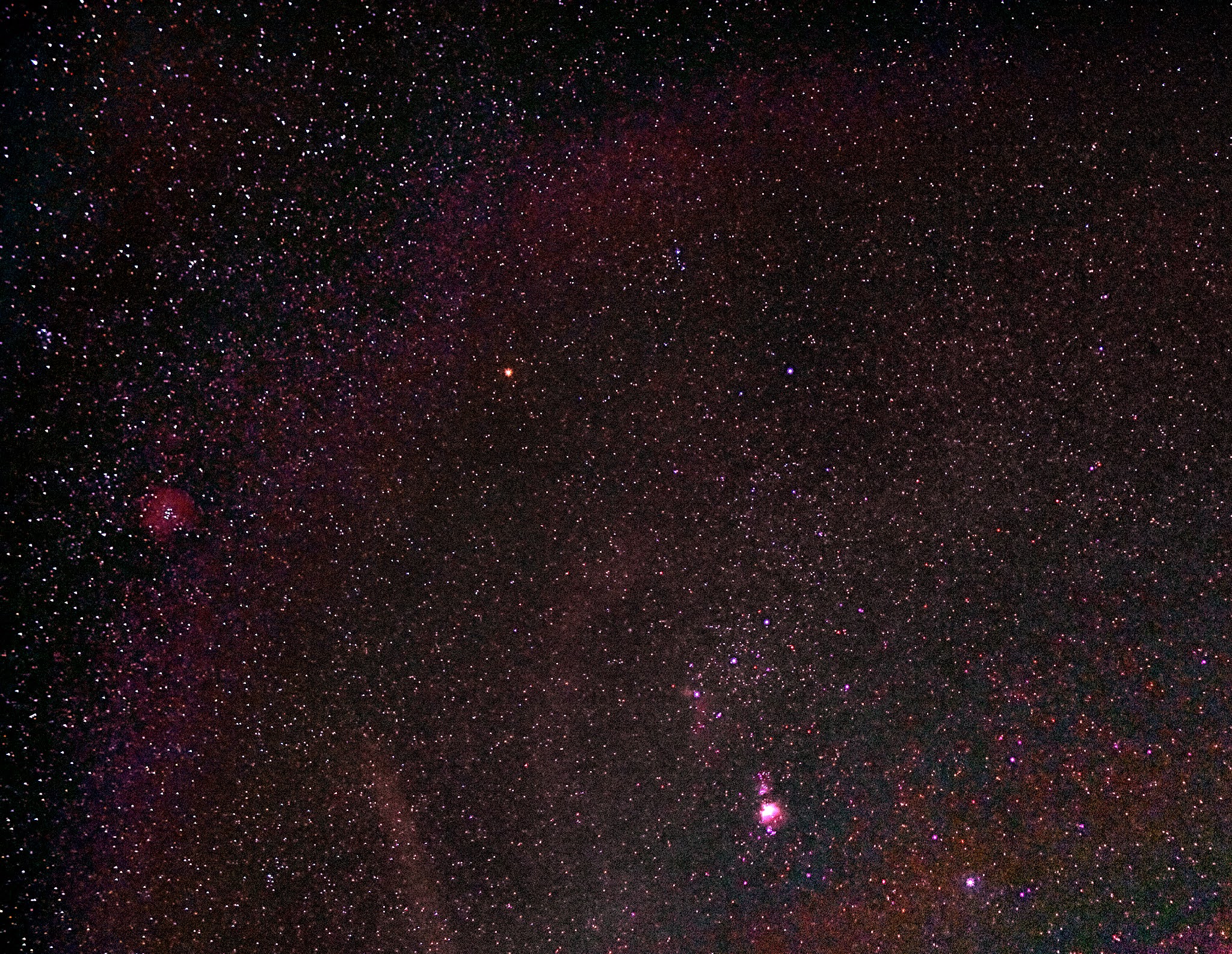
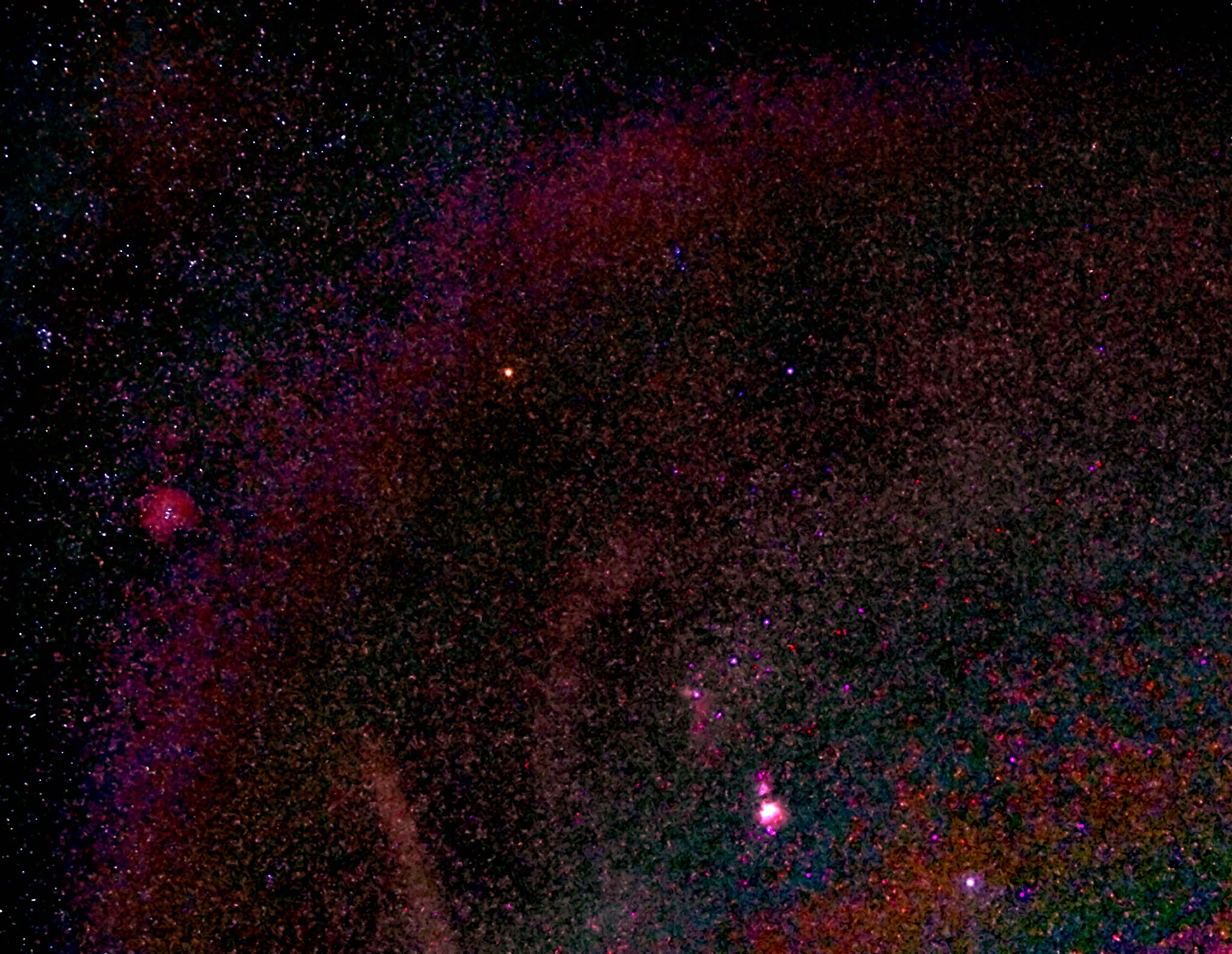
ONE CLEAR NIGHT 180 SHOTS ATTEMPT AT ORION WITH EF24 AND 90D


My Orion shot with EF24/1.4 @2.5 on moded EOS 90D, where I am now


The reference Orion, where I want to be.


Reference by Skypoints Photography
EXIF
Canon EOS EOS Ra
Canon 24-70mm f/2.8 L ll @ 50mm
iOptron SkyTracker Pro
Sky:
4 panel panorama, each a stack of 7 x 60s @ ISO1600
Foreground:
Panorama of 4x 2s @ ISO400 during blue hour


Wednesday, November 3, 2021

ORION AND FRIENDS ARE BACK!

I did a quick run of the EOS 90D (moded) with Samyang AF85/1.4 shot at f1.4 and ISO2000 ... untracked. It's been quite some time since the sky cleared, even for these shots clouds moved in quite quickly after only 20 shots. Purple fringing on the AF85 is quite strong as observed on previous occasions.

Since 90D is a cropped body these shots below are effectively 85x1.6mm focal range ie. 135mm. My Samyang 135mm would be changed to 216mm focal length, and the Askar 200mm with light pollution filter would be 320mm!!!


Part of Orion with Samyang 85mm on 90D moded, single shot, untracked


Pleiades 8 shot stack on Sequator152


Orion 10 shot stack on Sequator152


This will be my reference shot : Shot on my Sky-Watcher star adventurer tracker with Canon 5D Mk4 and 24-70 lens. Around an hours worth of images combined to increase the information captured, then stacked together in DSS and processed in Photoshop.


Friday, March 1, 2019

Orion in March

After almost a week of cloudy and/or foggy sky the stars revealed themselves when both elements took flight finally. Though they are not completely gone it was clear enough for some night time imaging.


The night sky full of stars 28th Feb/01st Mar 2019

Star Adventurer for trail-less longer exposures.


The constellation Auriga with it's brightest star Capella almost directly overhead 01st Mar 2019.


While some friends were chasing KP3-4 aurora in the moisture laden lower elevation sky, I decided to give the stars a shot or two. The temperatures wasn't extreme but the grip of winter has completely been let go so it was cold around midnight, colder still when wind blew.


I attempted another session at Vaulen with the intention of getting away from light pollution, however being located right smack in the city this proved rather futile. Light pollution is everywhere and it seems you can't escape it no matter where you are in the city.


Sunday, February 24, 2019

Stars up above

It was a partially foggy late afternoon which extended well into night time. By 2100hrs from where were standing you could clearly see the thin fog hanging in the air. Further above Leo, Orion, Gemini and Cassiopea were clearly visible. Half of Orion was dipping in the fuzzy fog. By 2400hrs the clouds came in rapidly from the south.

Orion in the fog.

Orion higher up.

More Orion, the bottom city lights slightly tamed with a graduated filter.

Orion in bright city lights tempered by the fog.

Pleaides and friends at 30 secs exposure on the 24mm.

Leo

The Bigger Dipper.

Saturday, February 16, 2019

Almost 8 hours of clearsky and there's a Moon.

Expectations were high approaching the weekend ... the sky was clear with no clouds in sight from mid afternoon all the way til the wee hours of the next day. The temperatures seemed mild too, above 5 deg C. And then of course there the moon which hung around from noon till 5 am the next day.


Orion was willing, the sky was willing, even winter temperatures cooperate willingly ... and the moon too. 


One makes do with what one has, you can go out buy gear but you can't go out buy perfect alignment of the universe for that perfect imaging night. Unless you are in the Atacama Desert or Tenerife ... maybe.

Wednesday, January 30, 2019

Orion

Orion and clouds, Sony A7S+Elmarit 35/2.0

Monday, January 28, 2019

Orion, single shot and stacked shot

Stacking fully aligned star shots is made possible with Star Adventurer. The unit with a camera sitting on top of it  follows the earth's rotation around the polar axis thus should eliminate the issue of star trails especially for long exposures. Multiple single shots exposure are taken over a certain time window, then these shots are stacked with a chosen stacking software. The reference standard software for stacking has always been the Deep Sky Stacker. DSS is available for free from the web. It has all the buttons you need for a successful stacking operation.

Since swapping laptop this year I'm no longer able to use some of my favorite softwares among them DSS and Photoshop. So now for a quick and dirty stacking I use Sequator which was recently made available by it's developer also free of charge. It is so much easier to use however with much less options for tweaking the stacking process.

One single shot at 15secs tracked.

A stacked of 12 tracked shots at 15sec each.

The view beneath that of Orion (stitched), light pollution is the bigger issue with astrophotography.

Milkyway from Sulaskard 2017 f/1.2 @ f/2.8 on Sony A7S, single shot tracked, minimum light pollution.


The main isssues with trying to image the night sky falls into two main categories. Those within a photographer's control: 
1) Aperture - wider aperture lets in more light, thus shorter exposure time, less noise, less trailing
2) Sensor size - larger sensor, less noise.
3) Earth's rotation - compensated for by star a tracking device, longer exposure, less need for widest aperture

And the issues outside of a photographer's control :
1) Weather - not much one can do other than more to Tenerife and pray for clear sky
2) Light pollution - seek dark sky (within our control to a certain measure)

A star tracker could possibly solve item 1 and 2 in one swipe, with the tracker you can probably get away with a crop camera, an f/4.5 lens and stacking combination. However the same combination with a fullframe camera and an f/1.2 lens would take your image that much further than a crop sensor  can.

It took me many years to progress from shooting stars and Milkyway with a crop sensor and f/4.5 lenses purely on a account of cost, and partly commitment. Then I saw a lot more of the sky when I moved to fullframe and f/1.2 (big glass) lenses. Then I bought the Skywatcher Star Adventurer, it took me about  a year before I actually dragged it out for a session with the Milkyway.

As for my night sky imaging, I can say that I'm working hard on the motivation and commitment on my part. Along the journey I've also picked up a couple of f/1.4 lenses as well as tripods.

The best I could do with a tripod, crop sensor Canon 40D and f/4.5 lens ... trying to capture fireflies and the stars at Sg Kadulit, Kuala Suai, near Miri, Sarawak. This was several years before Sony A7S!

An attempt at Milkyway (Sep 2011) with Canon 40D+Tokina 16-35/2.8: Iso1000, 30secs,f/2.8. I was shooting Jpeg, WB 5000.